
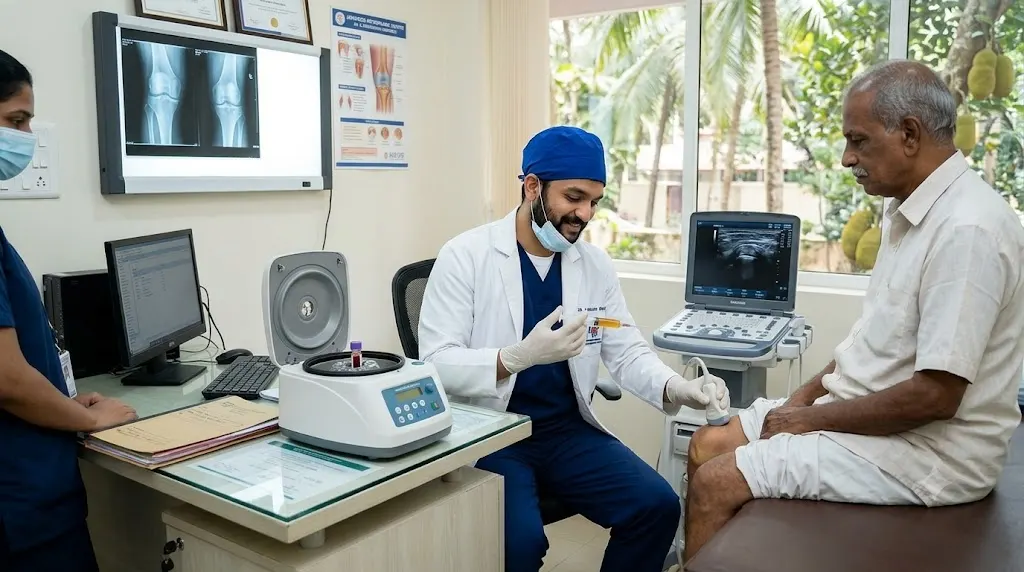
Platelet-Rich Plasma (PRP) Therapy | Advanced Orthopaedic Centre | Dr K Damodaran Memorial Hospital, Kollam
Introduction
Knee osteoarthritis is one of the most common causes of chronic knee pain, stiffness and difficulty walking. It occurs when the protective articular cartilage covering the ends of the bones gradually wears away, resulting in joint pain, inflammation and reduced mobility.
While conventional treatments such as medications, physiotherapy, lifestyle modification and intra-articular injections can help manage symptoms, some patients continue to experience discomfort and functional limitations.
Platelet-Rich Plasma (PRP) therapy is an emerging biological treatment option for selected patients with knee osteoarthritis. It uses a concentrated preparation of the patient's own blood platelets, which contain several growth factors and biologically active proteins that may help modulate inflammation and improve the joint environment.
PRP offers a minimally invasive, non-surgical treatment option for appropriately selected patients who wish to manage knee pain and maintain their mobility.
What is PRP Therapy?
Platelet-Rich Plasma (PRP) is a preparation obtained from the patient's own blood. It contains a higher concentration of platelets than normal circulating blood.
Platelets are best known for their role in blood clotting. However, they also contain numerous growth factors and signalling proteins involved in tissue repair and inflammatory regulation.
Some of the important growth factors present in platelets include:
-
Platelet-Derived Growth Factor (PDGF)
-
Transforming Growth Factor Beta (TGF-β)
-
Vascular Endothelial Growth Factor (VEGF)
-
Insulin-Like Growth Factor (IGF)
-
Epidermal Growth Factor (EGF)
These biological mediators may influence inflammatory pathways and cellular activity within the osteoarthritic knee joint.
How Does PRP Work in Knee Osteoarthritis?
In knee osteoarthritis, cartilage degeneration is accompanied by inflammation and changes in the joint environment.
PRP is believed to work through several biological mechanisms:
-
Modulation of inflammation: PRP contains biological mediators that may influence inflammatory pathways within the joint and help reduce inflammation associated with osteoarthritis.
-
Reduction in pain: By modulating the inflammatory environment, PRP may help reduce knee pain and improve patient comfort.
-
Improvement in joint function: Clinical studies have reported improvements in pain scores, stiffness and functional outcomes following PRP injections in selected patients.
-
Support of joint tissue health: Growth factors in PRP may influence the activity of cartilage cells and other joint tissues. However, PRP has not been proven to reliably regenerate lost articular cartilage or reverse advanced osteoarthritis.
Who Can Benefit from PRP Injections?
PRP treatment may be considered in patients with:
-
Early to moderate knee osteoarthritis.
-
Persistent knee pain despite appropriate conservative treatment.
-
Difficulty walking, climbing stairs or performing daily activities.
-
Symptomatic knee osteoarthritis in patients who wish to explore non-surgical treatment options.
-
Patients who are not suitable for surgery or wish to postpone knee replacement after understanding the limitations of injection therapy.
PRP is generally considered more appropriate for selected patients with mild to moderate osteoarthritis (Kellgren-Lawrence Grades I–III).
Patients with advanced Grade IV osteoarthritis and severe joint-space narrowing are less likely to benefit. In such cases, total knee replacement may be a more appropriate treatment option.
How Is PRP Injection Performed?
PRP treatment is a minimally invasive outpatient procedure. It generally involves the following steps:
-
Step 1: Blood collection. A small quantity of blood is collected from the patient's arm under sterile conditions.
-
Step 2: Centrifugation. The collected blood is processed using a specialised centrifuge to separate its components and prepare platelet-rich plasma.
-
Step 3: PRP preparation. The platelet-rich fraction is carefully collected using an appropriate preparation system.
-
Step 4: Injection into the knee joint. The prepared PRP is injected into the knee joint using strict aseptic precautions. Ultrasound guidance may be used when clinically appropriate to improve injection accuracy.
-
Step 5: Post-procedure care. The patient is observed briefly and can usually return home on the same day. Appropriate activity modification and rehabilitation advice are provided.
How Many PRP Injections Are Required?
The number of injections depends on the patient's symptoms, severity of osteoarthritis, PRP preparation system and treating surgeon's protocol.
Some treatment protocols use a single injection, while others involve a series of two or three injections at intervals.
There is currently no universally accepted standard injection protocol that is proven to be superior for every patient.
Your orthopaedic surgeon will determine the appropriate treatment schedule following clinical and radiological assessment.
What Are the Benefits of PRP Therapy?
Potential benefits of PRP injections include:
-
Minimally invasive treatment.
-
Uses the patient's own blood.
-
No major surgical incision or hospital admission.
-
May reduce knee pain and improve mobility.
-
May improve functional outcomes in selected patients.
-
Relatively low risk of serious complications when performed with appropriate sterile precautions.
-
Can be incorporated into a comprehensive knee osteoarthritis management programme.
Importantly, individual responses vary, and improvement cannot be guaranteed.
How Long Does It Take for PRP to Work?
Unlike local anaesthetic or corticosteroid injections, PRP is not intended to provide immediate pain relief.
Some patients begin noticing improvement over a few weeks, while others may take longer.
Clinical improvement, when it occurs, may continue over the following months. The duration of benefit varies depending on the severity of osteoarthritis, patient characteristics and PRP preparation.
PRP does not stop the natural progression of osteoarthritis in every patient.
Are There Any Side Effects or Risks?
PRP is generally well tolerated because it is prepared from the patient's own blood.
However, possible side effects include:
-
Temporary increase in knee pain following injection.
-
Mild swelling or stiffness.
-
Bruising or discomfort at the blood collection site.
-
Rare risk of joint infection.
-
Occasionally, an inflammatory reaction following injection.
Strict sterile precautions and appropriate patient selection are essential to minimise complications.
PRP vs Hyaluronic Acid vs Corticosteroid Injections
These are different types of injections used in the management of knee osteoarthritis.
| Source | Patient's own blood | Manufactured joint lubricant | Anti-inflammatory medication |
| Main purpose | Modulate joint inflammation and biological activity | Improve joint lubrication | Reduce inflammation |
| Onset | Usually gradual | Variable | Often relatively rapid |
| Duration | Variable; may last several months | Variable | Often short-term |
| Evidence | Promising but heterogeneous | Mixed evidence | Established short-term symptom relief |
The choice of injection depends on the patient's symptoms, disease severity, medical history and treatment goals.
Is PRP Better Than Knee Replacement?
No. PRP and total knee replacement are treatments for different stages of knee osteoarthritis.
PRP may be considered in selected patients with mild to moderate osteoarthritis who continue to experience symptoms despite conservative treatment.
Total knee replacement is an established surgical treatment for patients with advanced osteoarthritis, severe pain and significant functional limitation.
PRP should not be used as a substitute for knee replacement when surgery is clinically indicated.
Can PRP Reverse Knee Osteoarthritis?
This is one of the most common questions patients ask.
Currently, there is no convincing clinical evidence that PRP can restore completely lost cartilage or reverse advanced osteoarthritis.
Its potential benefits are primarily related to pain reduction, modulation of inflammation and improvement in knee function.
It is important to have realistic expectations before undergoing treatment.
PRP Along With Physiotherapy and Lifestyle Modification
PRP should not be considered a standalone treatment for knee osteoarthritis.
A comprehensive management programme may include:
-
Weight management to reduce stress on the knee joint.
-
Quadriceps and hamstring strengthening.
-
Low-impact aerobic exercises such as cycling and swimming.
-
Physiotherapy to improve knee mobility and muscle strength.
-
Activity modification when necessary.
-
Appropriate medications when indicated.
Combining these measures with PRP may help improve overall treatment outcomes.
Frequently Asked Questions (FAQs)
1. Is PRP injection painful? Blood collection and knee injection may cause mild discomfort. Most patients tolerate the procedure well.
2. Is PRP safe? PRP uses the patient's own blood, reducing the risk of immune reactions. However, temporary pain, swelling and rare infection are possible.
3. Can PRP delay knee replacement surgery? Some patients may experience sufficient symptom improvement to postpone surgery. However, PRP cannot guarantee that knee replacement will be avoided.
4. Is PRP effective in Grade 4 knee osteoarthritis? The response is generally less predictable in advanced Grade IV disease. Patients with severe cartilage loss and significant deformity are less likely to benefit.
5. How long does the procedure take? The procedure is generally completed as a day-care treatment, including blood collection, preparation and injection.
6. Can I walk after PRP injection? Most patients can walk after the procedure, although temporary activity modification may be recommended. The treating surgeon will provide individualised instructions.
7. Can both knees be treated with PRP? Yes. Both knees can be assessed and treated when clinically appropriate. The treatment plan depends on individual symptoms and clinical findings.
8. Does PRP contain any artificial chemicals or steroids? PRP is prepared from the patient's own blood. It is not a steroid injection. Its composition depends on the preparation system used.